





Refusal of Unsafe Work
The District supports the position that no employee shall carry out or have cause to carry out any work process and/or operate any tool, appliance or piece of equipment, when that person has reasonable cause to believe that to do so would create an undue hazard to the health and safety of any person.
This section outlines the processes when reporting and investigating a refusal of unsafe work and other FAQ.
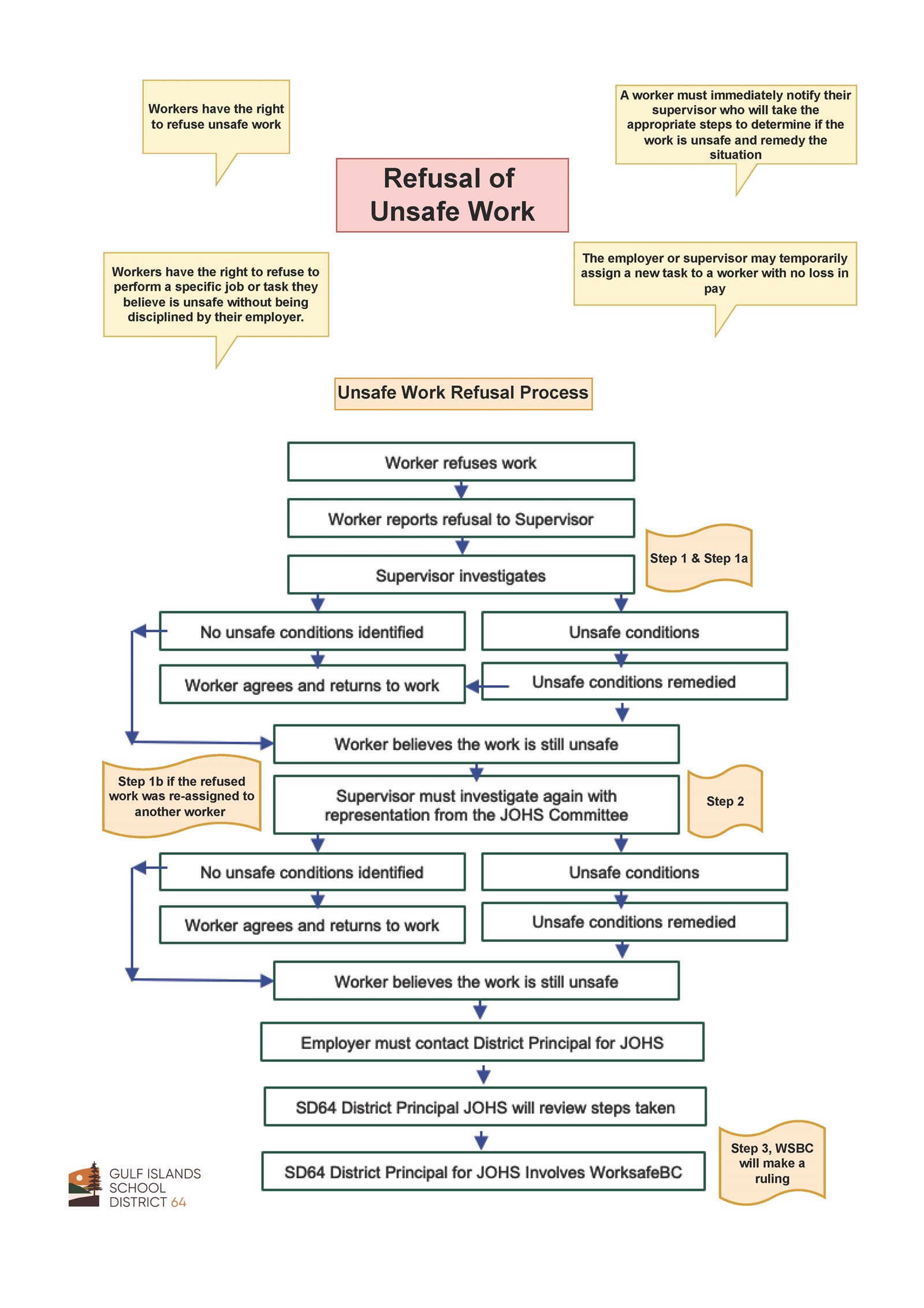
Flow Chart: Refusal of Unsafe Work
- Supervisor Forms: Refusal of Unsafe Work
Frequently Asked Questions in K-12 Public Education
The refusal of unsafe work process is outlined in section 3.12 of the Occupational Health and Safety Regulation (The Regulation). Every worker has this right. The Regulation is clear about the rights and obligations of workers and employers respectively. However, when working with student behaviour it can be more complex and nuanced; this is the focus of this Frequently Asked Questions (FAQ).
It is impossible to define every situation in an FAQ document. Your specific context must always be considered. Use these questions and responses to support your internal responsibility system and facilitate the decision-making process. Accommodation questions are not considered in this FAQ.
General refusal to work questions
1. What is the difference between reporting an unsafe condition and refusing unsafe work?
Reporting an unsafe condition is a preventative step that a worker must take to support workplace safety. Whereas refusing unsafe work is a right and an obligation to not perform work when there is an undue hazard to any person.
2. I don’t think that the hazard of my work meets the definition of undue hazard, but it just doesn't feel safe, now what do we do?
Report to your supervisor as required by section 3.10 of The Regulation.
3. I have never raised a safety concern at any job before. I am nervous about what others might think if I refuse what I see as unsafe work. What should I do?
Report the safety concern to your supervisor and see if an investigation is underway. If you objectively believe that doing the work would present an undue hazard you must exercise your rights and obligations under the Workers Compensation Act (The Act) & Regulation.
4. Can a worker be disciplined for refusing work?
A worker can refuse unsafe work and an employer cannot subject the worker to reprisal, including discipline, for exercising their rights under The Act or The Regulation. If, after all the steps for investigating a work refusal have been followed, and WorkSafeBC has determined there is no undue hazard, then the worker is no longer protected from disciplinary action. Also see Section 3.13 of The Regulation for more information.
5. Can my employer send me home without pay after exercising my right to refuse unsafe work?
No, as per section 3.13 of The Regulation, a worker must not be subject to prohibited action because the worker has acted in compliance with section 3.12 or with an order made by a WorkSafeBC Officer. If, after all the steps for investigating a work refusal have been followed, and WorkSafeBC has determined there is no undue hazard, then the worker is no longer protected from disciplinary action. Also see Section 3.13 of The Regulation for more information.
6. Why can’t we just call WorkSafeBC right away to deal with the refusal of unsafe work?
The Workers Compensation Act and Regulation empowers and requires employers and workers to work together to address hazards and to ensure safe workplaces. The Right to Refuse process has very specific steps set out in The Regulation under section 3.12 that need to be followed. The last step is the worker and employer contact WorkSafeBC. See the process in “WorkSafeBC roles, rights and responsibilities Refusing unsafe work” at WorkSafeBC. (Workers have the right to contact WorkSafeBC at any time – Health and Safety assistance prevention information line: 1-888-621-7233 .)
7. I was pretty shaken up when I went home on Friday afternoon. I emailed my supervisor to let them know I am refusing unsafe work and will not be there until the situation with the student is resolved. Is there anything else I need to do?
The procedure for resolving a work refusal requires workers and employers to work together to resolve the problem, which will require you to be present. You need to be available when the employer investigates the matter, and your employer may assign you other work while the investigation is ongoing.
8. Do I need to be onsite to refuse unsafe work?
Yes, so that you can participate in the steps for investigating and resolving the work refusal.
9. How long should it take to resolve a refusal of unsafe work?
A report of unsafe work, and the refusal of unsafe work, must be immediately investigated, and some work refusals can be resolved right away. The time needed to investigate and resolve a work refusal may depend on the nature of the hazard, and whether the worker and employer can agree on how to solve the problem.
10. If WorkSafeBC determines there is no undue hazard, do I need to return to work?
The protection afforded by WorkSafeBC under The Regulation ends with the decision made by a WorkSafeBC Officer. Not returning to work would not be covered under the right to refuse unsafe work process.
11. Are workers required to follow safe work procedures?
Yes, workers are required to follow established safe work procedures. Where a worker believes a safe work procedure does not address the hazards, they must report to their supervisor or employer as soon as possible.
12. Can more than one worker refuse unsafe work at the same time?
Yes, however the procedure for refusing unsafe work generally works best when each worker makes their own reasoned assessment of the hazard, reports the unsafe condition, and participates in the investigation. Due to differences between individual workers, what may be unsafe for one person, may not be unsafe for another. For example, one person may have the required training to do the work and the other does not. Once the work refusal has been initiated there are protections for other workers who may be subsequently asked to perform the refused work. Including the requirement for employers to provide them with specific written notice.
13. Can a third-party representative, who is not exposed to the hazard, initiate a refusal of unsafe work on behalf of a worker or group of workers?
No. The obligation to report and refuse unsafe work is the obligation of the worker who believes there is an undue hazard. A worker may seek the advice or assistance of a union or other representative, but the obligation to report and refuse unsafe work remains that of the worker.
Reassignment of refused work
14. Why didn’t I receive written notice when I was assigned to work with a student that another worker had refused unsafe work about?
Written notice is not required if the issue has been corrected or the refusal process has been resolved.
15. Can I refuse re-assigned work as “unsafe work” if I have not received the required written notice?
First, confirm with your supervisor if the work you have been assigned is part of an ongoing unsafe work refusal process and discuss next steps, including receiving written notice when required. Regardless of whether you receive written notice, if you are asked to carry out work where there is an undue hazard and a reasonable belief you are at risk of injury, you must refuse unsafe work.
Student related refusal of unsafe work questions
16. Can an undue hazard exist when working with a student?
Yes, an undue hazard could exist when working with a student. However, each situation requires a review to ensure that control measures are sufficient. If controls are in place and communicated and all required items are listed in the Individual Safe Work Instruction (ISWI), it is less likely that an undue hazard exists. The ISWI must be consistently updated and current to the needs of the student and workers to reduce the risk of an undue hazard occurring.
17. Does WorkSafeBC expect elimination of the hazard when it comes to violence involving students’ actions towards workers?
Section 4.29 (a & b) of The Regulation outlines that the employer must establish procedures, policies, and work environment arrangements to eliminate the risk to workers from violence and, if elimination of the risk to workers is not possible, establish procedures, policies and work environment arrangements to minimize the risk to workers.
18. Working with a student who exhibits externalizing behaviour causes me to become anxious. Could this be considered a valid opportunity to refuse unsafe work?
No, you may wish to discuss your concern with your employer (section 3.10). Feeling uncomfortable does not necessarily constitute an undue hazard in the workplace. The ISWI should outline the known hazards associated with working with the student and the control measures to minimize the risk of injury to the worker. A worker requiring accommodation for a diagnosed medical condition that may affect their ability to safely perform the work should discuss any limitations with their employer.
19. If I refuse unsafe work does the student need to go home?
No, the right to refuse unsafe work applies to the worker’s rights within the employment relationship and is separate from decisions made regarding addressing the student behaviour. Workers should work with their supervisor to remedy the immediate situation using the hierarchy of controls.
20. Does WorkSafeBC have the authority to direct the site supervisor to send a student home?
No, sending students home is not within WorkSafeBC’s jurisdiction. WorkSafeBC may require an employer to provide evidence that they have assessed workplace risks and implemented effective control measures to ensure the health and safety of their workers.
21. What is the best way to safely support a student exhibiting externalizing behaviour with potential to cause harm to others?
Guidance and instruction for safely supporting a dysregulated student is specific to each student and can be found in their Individual Safe Work Instruction (ISWI) for the student. When there is an ISWI in place, employees must read and follow the safe work procedures outlined in the document. Where a worker identifies that following the safe work procedures may lead to an injury, they must report their concern to their supervisor. (ACT 22 2(a & e))
22. I have not been given the opportunity to read or review the individual safe work instruction (ISWI) for a student who has previously caused harm to others. Can I refuse unsafe work?
The first step is to speak to your supervisor and obtain the Individual Safe Work Instruction (ISWI) document. Your supervisor will provide time for you to review the ISWI prior to working with the student. All workers must be familiar with and follow the ISWIs when working with students that have them, including principals and administrators. If, after the ISWI has been reviewed and any additional concerns have been brought to your supervisor, you still have reasonable cause to believe there is an undue hazard, you can exercise your right to refuse unsafe work.
23. I have read the individual safe work instruction (ISWI), but I am still worried that I will get hurt, should I refuse unsafe work?
The ISWI attempts to outline the process that, if followed, will minimize the risk to the worker. As per The Act section 22 and section 3.10 of The Regulation, a worker must report to their supervisor why they objectively believe the work is unsafe. If after the investigation by the supervisor, including a discussion with the worker, the worker still believes there is an undue hazard the worker must refuse unsafe work.
24. As an educational assistant or student support worker can I be assigned to another student or to other duties while refusing unsafe work?
Yes, you could be temporarily assigned to another student or to other duties.
25. Do I have to be injured by a student before being able to refuse unsafe work?
No, refusal of unsafe work is a right for all workers when there is reasonable cause to believe the work creates an undue hazard. You must immediately report the circumstances of the unsafe condition to your supervisor or employer.
26. I no longer want to work with a student after repeated incidents and it has been determined that the student’s actions are not an undue hazard. Can I initiate the refusal of unsafe work process if I would prefer not to work with them?
This would not be grounds for refusal of unsafe work. Discuss the matter with your supervisor.
Non-student related refusal questions
27. If my workplace is too hot or too cold, could it be considered unsafe work?
Typically, when factors such as intensity of work being done, clothing required to be worn, humidity and acclimatization are considered, indoor workplace temperatures do not reach the extremes required for them to be considered unsafe to work in. The Regulation includes requirements for both heat and cold exposure in the workplace in Part 7. There are several guidelines that provide guidance around thermal exposure. If you believe there is an undue hazard report it to your supervisor. WorkSafeBC Guideline 3.12.
28. Can an extreme environmental event be considered an undue hazard warranting a refusal of unsafe work? (e.g., wildfire smoke, heat dome)?
Yes, if the worker has reasonable cause to believe it presents an undue hazard to themselves or any person. Exposure to extreme environmental events in light duty work environments would generally present no greater risk than not working. For workers engaged in more strenuous physically demanding work or where environmental conditions are concentrated locally within a building, may present a greater risk requiring further investigation. Report the hazard to your supervisor.
29. Are there situations where hazards are present but may not meet the definition of an undue hazard? For example, these could include going on a roof, entering confined spaces, operating mobile equipment.
Yes, employers are required to have instructions for workers where there is a risk of injury related to carrying out a task.
30. have been asked to retrieve a ball from the roof of the school and I believe this task is an undue hazard, should I refuse unsafe work?
The first step would be to report the hazard to your supervisor. The supervisor must immediately investigate the reported hazard. If the investigation concludes that there is not a hazard and you are then directed to complete the task, and you still have reasonable cause to believe that the undue hazard exists, then you must refuse unsafe work.
31. Is participating in safety training mandatory?
- Yes, the employer is required to provide both orientation and training to workers, and workers, including supervisors, are required to participate.
 Google Translate